Gregor the Overlander by Suzanne Collins
The first chapter of Suzanne Collins's debut novel

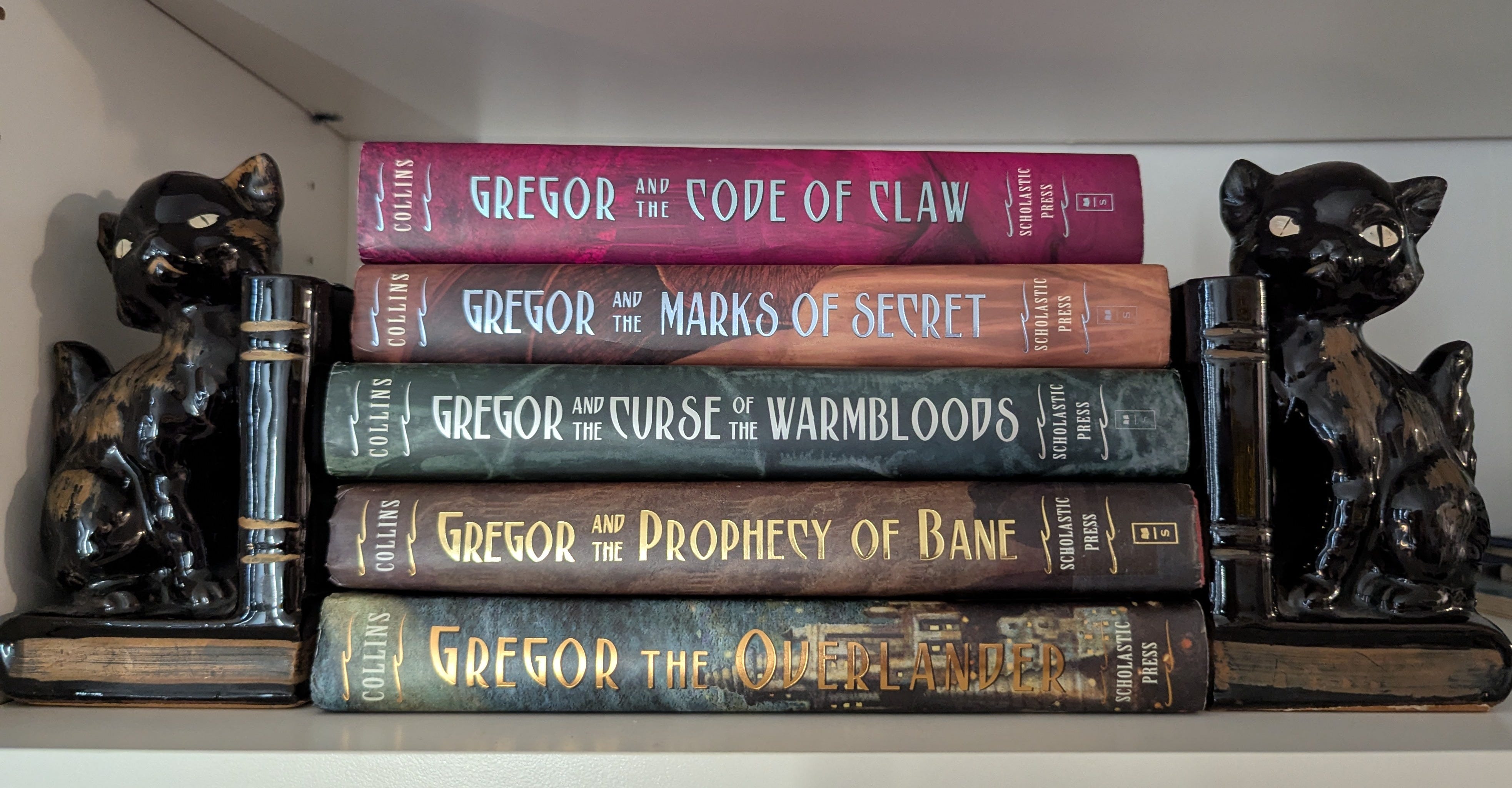
My first thought was to do Practical Magic by Alice Hoffman because I’m a huge Hoffman fan and excited for a second movie, but that novel is in sections and the first section is 45 pages long. So I started reviewing The Man Who Saw Everything by Deborah Levy. Then my birthday on Wednesday brought me the lovely gift of the Gregor the Overlander series by Suzanne Collins, so obviously I needed to make that my first post. Fans of The Hunger Games, I highly recommend her other series. It is middle grade, so a quick read, but no less engaging.
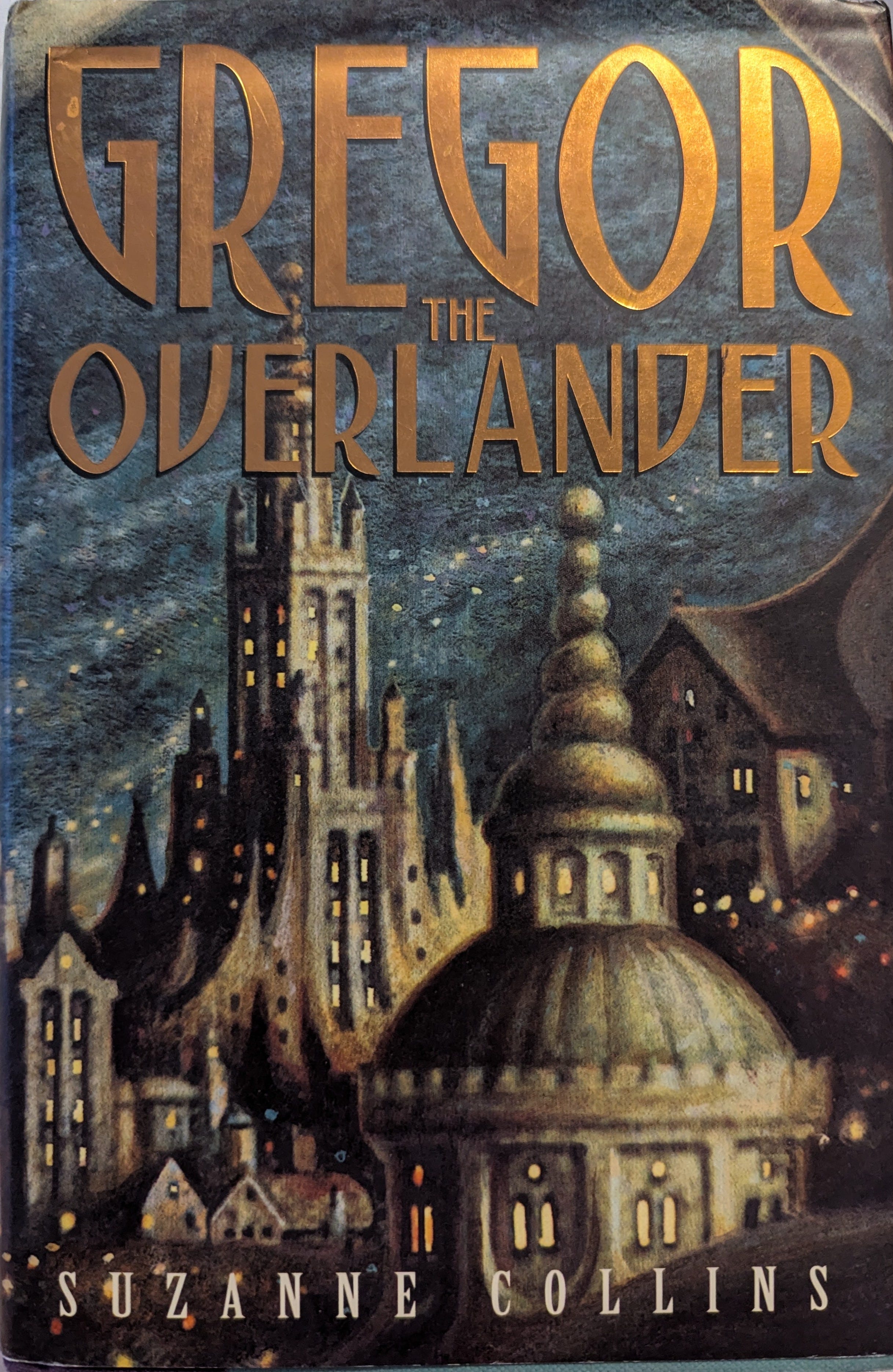
This was Collins’s debut novel! She’d written for television before, most notably (for me) was Clarissa Explains it All because I loved seeing a teen girl into tech and cars. Clarissa had a pet alligator and made video games. Baller.
Gregor the Overlander is a portal story about eleven-year-old Gregor, who falls through a laundry vent with his younger sister, and chaos ensues. It is a plot-driven novel for middle-grade readers, so I’m going to look at how certain writing elements work in supporting those categories.
What Happens?
The novel opens with Gregor pressing his face against the screen door so hard it leaves marks. He frustrated (by something—we don’t know what yet, that’s the mystery!), it’s summer, and he’s hot. We quickly learn the basics of his situation: he lives in a small apartment with his mom, grandmother, and two younger sisters, Lizzie (7) and Boots (2). Only one room has air conditioning, and that is reserved for Grandma and his sisters. We learn Gregor is frustrated because he cannot go to summer camp this year because Mom needs to work full time because Dad disappeared, resulting in the loss of an income and someone to watch the kids, and grandma isn’t lucid enough to watch Boots on her own. Three pages in, we learn Gregor is only 11 himself, but very aware of how his role in the family has changed since his dad disappeared a few years ago. We see him put on a tough face for his mom and pretend he doesn’t want to go to camp and is totally fine with Lizzie being able to go to camp.
Gregor has a touching conversation with his grandma that illustrates she has Alzheimer’s and currently believes she is back on the farm. Their neighbor, Mrs. Cormaci, stops by to make sure everything is okay and chats with the grandmother while Gregor and Boots do laundry. Internal thoughts tell us that Gregor’s father’s disappearance was cause for some gossip, but that Gregor doesn’t believe his dad ran off with another woman even though that’s what the popular community narrative is. In the communal laundry room, Gregor loads the washer while Boots plays with a little ball. Then Boots finds an open vent behind a dryer and crawls into it. Gregor lunges after her and down the two of them fall.
Why it Works
It’s a nice, short chapter, and we get a lot of basic information in a natural way. The basics are his family members and he and his sisters’ ages. Other information is woven throughout the details included. He and his family are not financially stable. They can only afford an AC unit for one bedroom. Multiple family members have to share a room. Mom cannot afford childcare. Basically, Dad disappearing had a huge snowball effect that the family is still trying to deal with.
We also get an emotional connection to Gregor. The novel opens on a scene of longing. Gregor’s looking at an empty courtyard because all the other kids in the building are off at summer camp. He’s feeling excluded, a very human emotion that is easy to relate to. Driving everything in this chapter is the disappearance of his dad. It’s the reason his mom needs to work more, the reason he cannot go to camp, the reason people ask him personal questions he doesn’t want to answer, the reason he is sad, and the reason he’s had to grow up faster than wanted or expected.
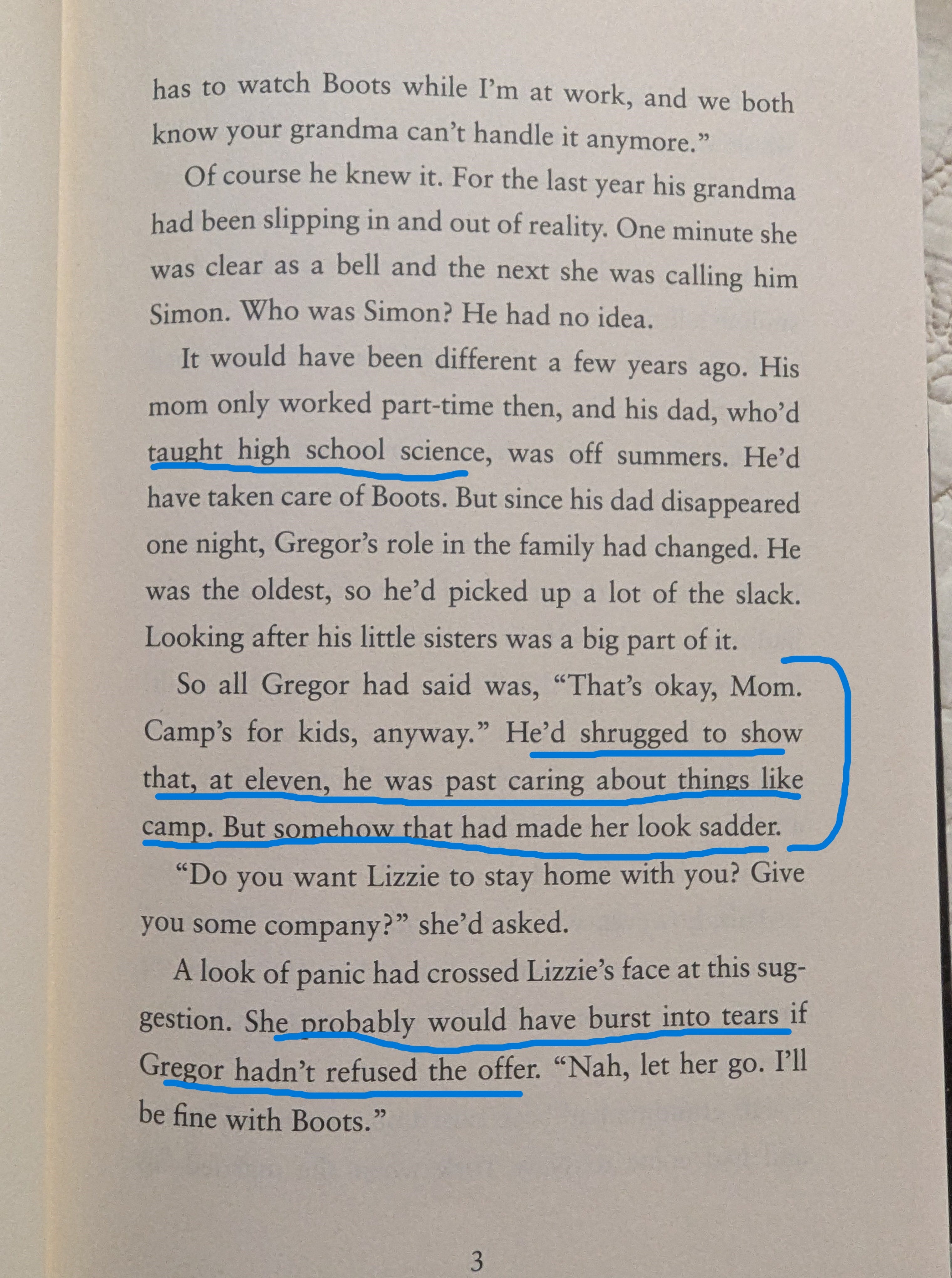
Collins lets Gregor’s actions define his character and deepen our emotional connection to him, so we care about his journey as a protagonist. He tells his mom camp is for kids, so she won’t feel guilty that he can’t go. He is kind to his grandmother when she has an episode, he helps with chores, and he plays with Boots, like a good big brother. We like him. He’s a good kid. While a likeable protagonist is not necessary for a successful story, it is one of the elements that make this first chapter successful.
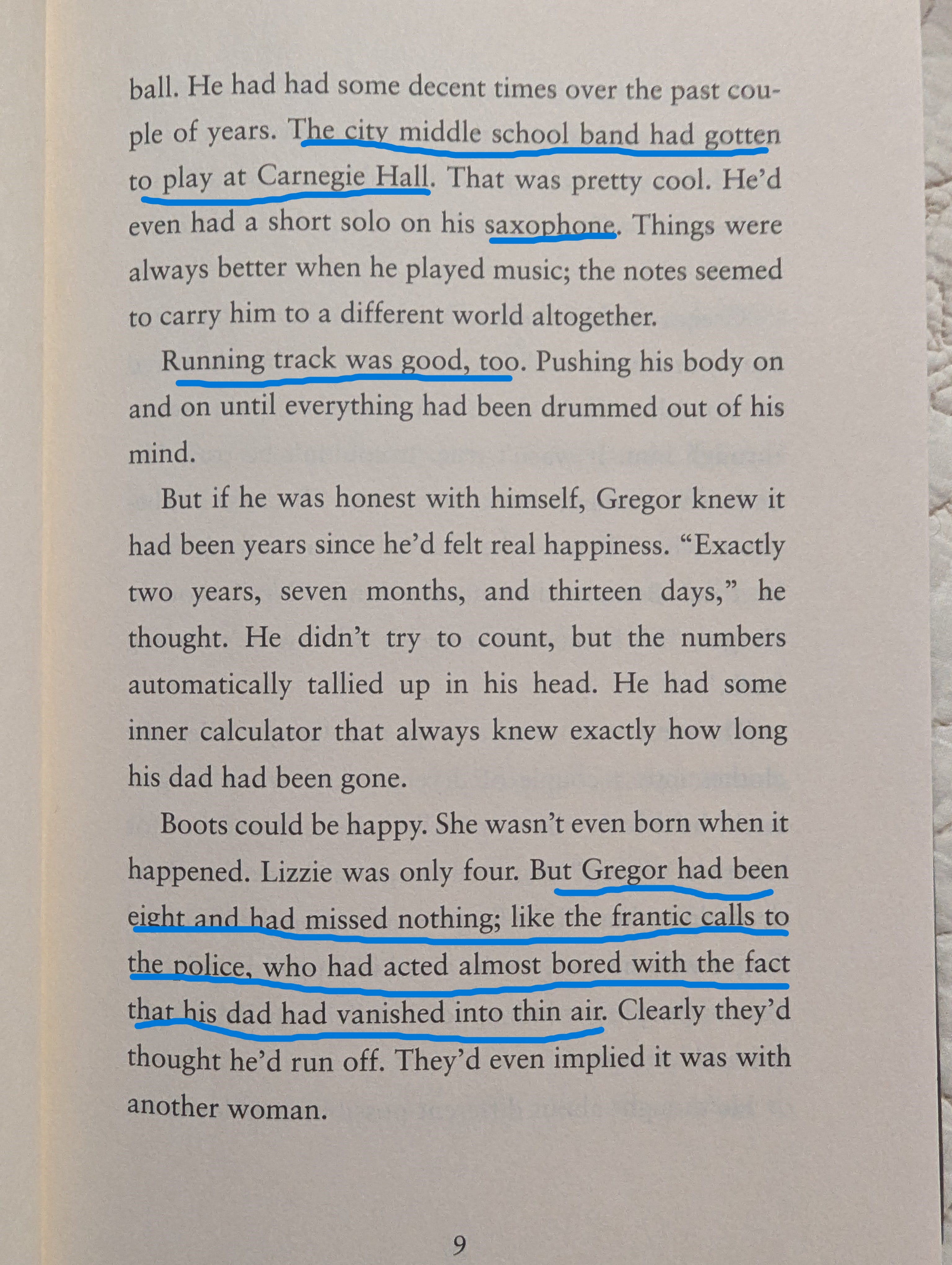
Collins balances this with Gregor’s internal dialogue to show how much his father’s absence affects him emotionally. Of course, anyone would be sad, and that is another way to engage the reader emotionally. But Gregor also expresses some jealousy because Boots wasn’t born yet when their father disappeared, so she can be happy since she doesn’t know what she’s missing. Gregor also provides commentary on society because he laments how easy it is for people to believe a rumor because it sounds good—his dad running off with another woman—rather than the truth that he just disappeared. Gregor has many different emotions, making him a well-rounded and interesting character.
The chapter ends on a cliffhanger, which, for an adventure story, is a great tool. How the heck did they fall down a laundry vent? Where does it go? What’s happening? Yup, just like Alice, Gregor is about to have his world turned upside down.
As noted in my introduction, Practical Magic and The Man Who Saw Everything are forthcoming. Tootles.