
Hot Takes #1
Premiere Paragraphs of Steller Shorts

Today I wanted to do something different. Novels get plenty of well-deserved love, but there is power in compression. A well-written flash or short story lingers, sometimes more than a novel. As much as I enjoy novels, I find myself reading a lot of flash fiction and short stories because I peruse literary journals.
Today, I’m going to look at opening lines and paragraphs of some short stories or flash pieces and talk about why they are powerful. I have three short story collections by single authors, but budding authors keep in mind these collections do not come out of thin air. If you enjoy writing short stories and want to publish your own collection one day, know that when an author puts together a collection, several of those stories were published in a literary journal first. Most literary journals have semi-free or fully free websites, which is great because it makes them more accessible.
I’ve picked three very different collections and three differently styled short stories to review, so there is something for various styles of writing. All of these collections are highly praised, and the stories within them have won awards. Some of the stories are available to read online for free where they were first published, so you can see which author resonates with you and know what to buy.
Before we Dive In, I’ve been posting about offering feedback on people’s First Chapter. There is a lot to set up with payments, FAQs, etc. It’s $50 for 5000 words. I’ll be making a separate post dedicated to it, but if you have questions, message me on Substack.
Alligator by David Ryan.
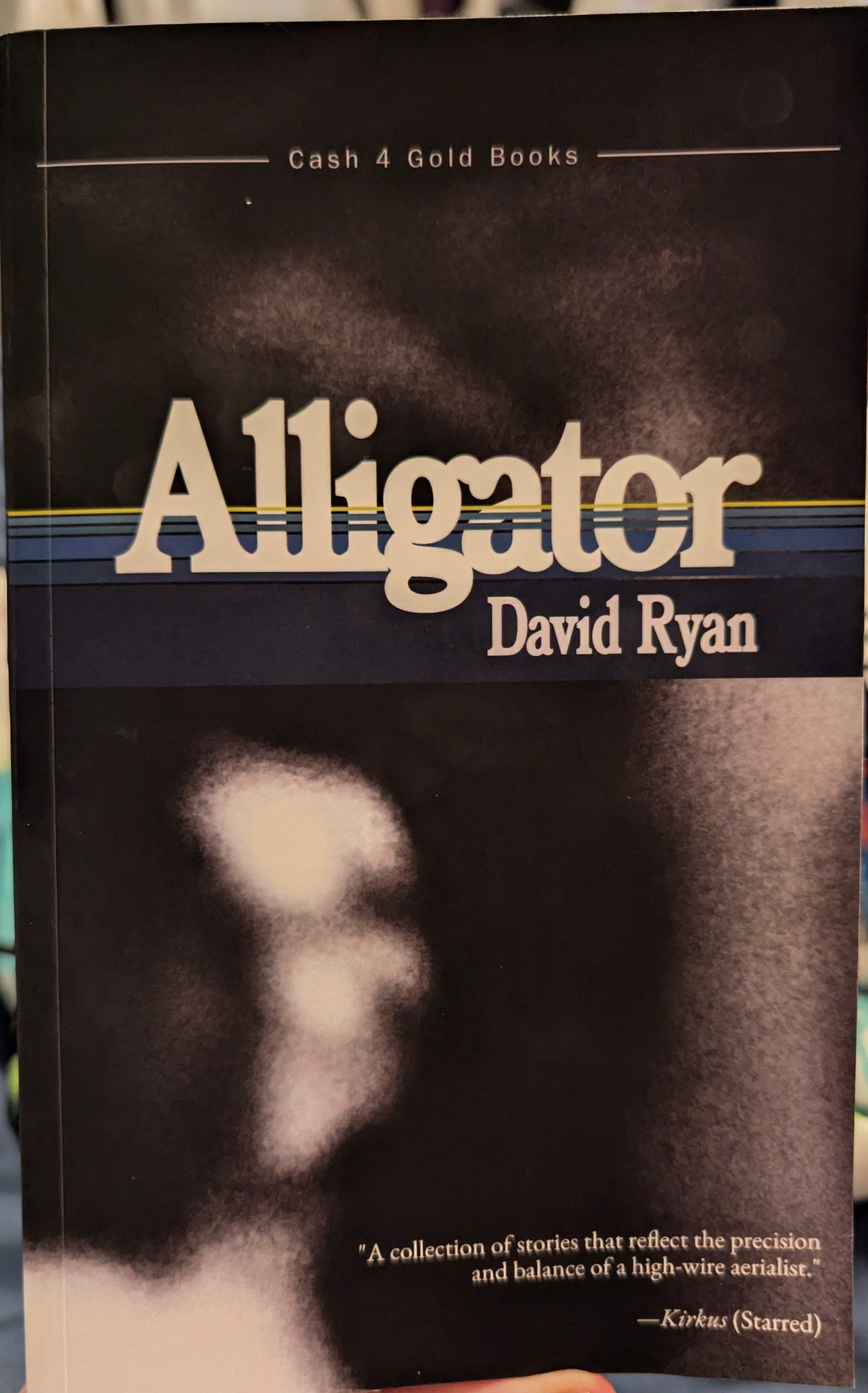
I had the immense joy and luck of taking a novel writing class with David Ryan while I attended Sarah Lawrence. He’s very detailed in his lectures, and he makes complex concepts quite accessible. This is his second collection of short stories, hot off the presses. His first is Animals in Motion. You don’t have to take my (albeit biased) word for it. Ryan has two O. Henry awards. TWO. Eudora Welty won two, William Faulkner won two, Joyce Carol Oates won two, and Flannery O’Connor won three. And many other authors of note are on that list. Plus, Rick Moody (another award-winning author) says, “David Ryan is one of the very best short story writers on earth. This is what genuine mastery of a form looks like. There aren’t even that many people who are close.”
“Sleepwalker”
“The first night your mom begins to sleepwalk, it’s the change of pressure in the air that wakes you, a draft pulling through the bedroom you can’t explain, that makes the curtains swell and exhale like disordered ghosts” (Ryan 231).
The opening line sets up the story by implying that the sleepwalking happens multiple times. That sounds simple. It is deceptively simple! It’s a clear, clean way of priming the reader for a series of nights where the mom sleepwalks. It does more work than you think. We wonder, like the child protagonist, what is making the mom sleepwalk.
Ryan also does this magical thing where he somehow describes the ineffable, the je ne sais quoi, the thing that can’t be described. A “change of pressure in the air” personifies the curtains in the room, making them “exhale” and likening them to “disordered ghosts.” I don’t know what a disordered ghost is exactly, but somehow with the description I can absolutely see the billowing curtains as disordered ghosts, like this is their first haunting and they forgot something and are zipping around.
Favorite Line: “What you see is the glowing tip of her cigarette dancing like a sprite” (Ryan 237).
Another great opening that has a lot of energy is “Impossible Object.” It begins, “The day he tells you he’s Jesus Christ you’ve been out driving for a couple of hours. You’re 14. George is 18. He’s driving…” (Ryan 131). It’s fast-paced and has an air of tension in that car.
Stories from the Tenants Downstairs by Sidik Fofana

I listen to The Sewanee Review podcast, and that is where I first came across Sidik Fofana’s work. Then, in the last semester of my MFA, he gave a talk about how to use lessons gleaned from hip hop in your writing. What a fantastic talk. BTW, a lot of those talks are open to the public, so if you live near Sarah Lawrence College, keep an eye on their visiting authors. Some of them are live-streaming as well, so you can watch even if you don’t live nearby.
Stories from the Tenants Downstairs is an interconnected collection. Each story is from a different resident in the building. It is the winner of the Whiting Award and a finalist for several other book awards.
“Tumble” is probably my favorite in the collection, though it is difficult to pick. It’s a revenge story of sorts, but certainly not your typical revenge story. Revenge isn’t quite the right word, but the story certainly touches on complex emotions such as jealousy, grief, anger, and sadness. It puts the protagonist in a situation where we as readers don’t know what we’d do. I won’t spoil it, but I loved the ending to this story. Fofana ends his stories well in general, but this one was powerful. The ending of “Lite Feet” is soul-crushing.
“Tumble”
“Usually, they give you time. You might see a notice on someone’s door for a whole year. Now, several units were getting one on the same day” (Fofana 175).
The story opens with a villain—the unnamed “they.” But we sort of know who they are. They are the people in charge, the ones who hold all the power and decide the fate of people they have never met. They do not consider circumstances. They are just doing their job. Huh, sounds so weirdly familiar. Anyways…
We are also given a problem and a time limit. Several units in the building are getting a notice on the same day. The opening paragraph implies several families are in danger of being evicted (there aren’t too many reasons for a notice on your door). There is a contrast, which suggests things aren’t as they used to be. Notices used to be on doors for months. But something has changed and now “twentysomething” families are getting a notice in one day. The time limit isn’t directly stated until later, but it is implied in the opening paragraph.
Then we get the inciting incident a few lines down. The protagonist is reading the list of people she needs to notify. “Then I get to one that cold knocks me out. I move it close to my face to make sure it’s not a mistake. Kya Rhodes” (Fofana 175). The rest of the story is about the protagonist’s connection to Kya and how that history influences her actions in the present.
Favorite Line: “I try to prepare myself to live with this, and stand my ground, but a thousand flies invade my heart” (Fofana 191).
Another strong opening is the collection’s premier story, “The Rent Manual.” It opens, “Days left: 10…money you got: $0…money you need: $350” (Fofana 3).
Goal + Time Limit = Pressure.
Shit Cassandra Saw by Gwen E. Kirby
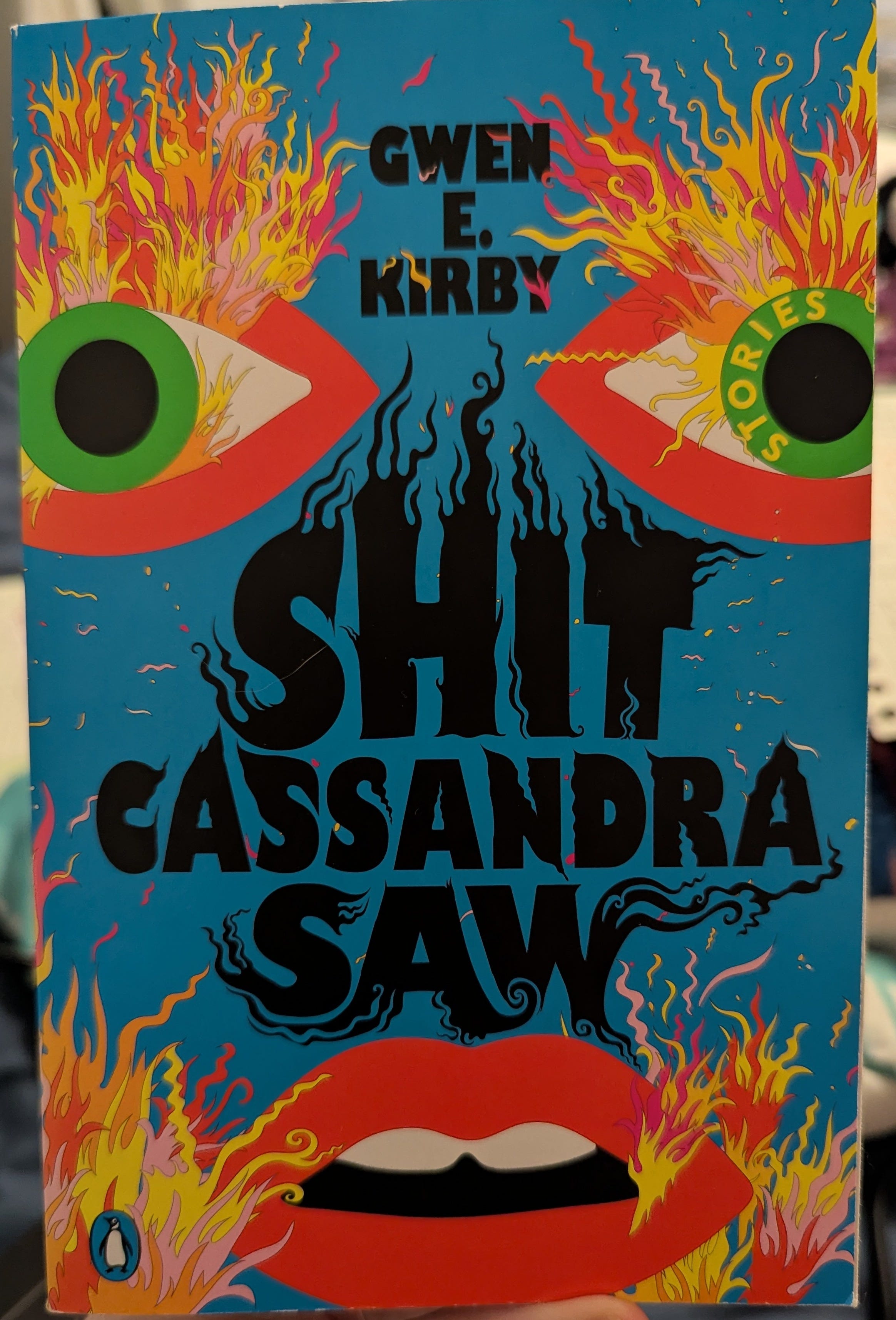
I think I also came across Kirby in a Sewanee Review podcast episode. Her stories are weird and powerful (and I love the cover design by Lydia Ortiz). Several experiment with form. My favorite one that plays with form is probably “How to Retile Your Bathroom is 6 Easy Steps.” It is both a story and a How-To. It’s great. Deeply funny and sad. She was at AWP 2025 on a panel about short stories.
Gwen E. Kirby is also a master at titling her stories. The titles of most of them could be micro-level stories in their own right. Today, I’m zeroing in on “Midwestern Girl Is Tired of Appearing in Your Short Stories.” And, golly, don’t you know exactly what the story will be about! But, you also don’t. This story is a satire, yes, and it’s making an argument about an overused trope. It also comments on craft and uses form to tell the story and make her point.
“Midwestern Girl Is Tired of Appearing in Your Short Stories”
“Midwestern Girl goes to New York City, and she reminds the protagonist (of course she is not the protagonist) of everything he has left behind. He covets her innocence and also despises it. When she gives up and goes home, he is sad, but not surprised” (Kirby 225).
I know we joke about romance movies being all the same (especially around Christmas because every streaming service has tried to replicate the Hallmark-esque formula), but the above paragraph summarizes dozens of plot lines.
To get where Kirby is going with this style, you need to look at the next paragraph. “A flick of your wrist. Midwestern Girl stands alone at a house party. The protagonist smiles at her, as if to say, cheer up and I notice subtle things, and this reminds the reader that the protagonist is secretly sensitive, no matter what terrible things he has done or will do…” (Kirby 225).
“A flick of your wrist” calls back to the title, calling out the you who is writing the story. Kirby is mocking how quickly the author changes a few circumstances, but overall uses the same trope. It’s lazy because it’s a stand-in without character development. The guy is a trope, too. The reader is prompted to see him as “sensitive” and forget anything that contradicts this.
[I’ve got nothing against tropes by the way! I don’t think Kirby does either, in general. It’s when a trope is done poorly, without substance, that it falls flat. That’s what she’s calling out here. She’s also calling out the tired way men write women.]
Favorite Line: “Does a kiss always taste so half-hearted?” (Kirby 228).
Another great opening is “Friday Night,” which is actually one looong sentence. I love stories meant to be read in one sentence because they leave you breathless in a way. The story opens, “My husband and I should be making a baby but instead we argue about whether to go out for Mexican or order pizza…” (Kirby 49).
(I wrote a flash piece that is one long sentence, but it’s still looking for a home, though it’s gotten some personalized rejections, which is nice.)
I hope you’re inspired to read some more short stories. Short story collections actually don’t get enough love, and therefore are more difficult to publish unless the writer already has clout. So if you can, purchase short story collections and help out the author. Or, subscribe/donate to a smaller literary journal, especially if they pay their writers.
I have a doozy of a goal for my post next week. In preparation, please watch Christmas with the Kranks (2004) (based on the novel Skipping Christmas by John Grisham). I will not explain. Just watch and enjoy Jamie Lee Curtis, wacky antics, and insanity. Then next week you will be ready for my post.
Cheers! XOXO.
My latest publications.
“When You Find the Secret Tunnel Hidden Behind the Panel,” flash fiction, A Curious Moon Issue 2, Dec. 2025
“Kaleidoscope,” micro fiction, Silly Goose Press Issue 6, Nov. 2025
“New Yorkers,” flash fiction, Etched Onyx Issue 18, Sept. 2025
“Blood Pudding,” flash fiction, The Mersey Review Issue 7, Aug. 2025